Racing The Trafalgar Way
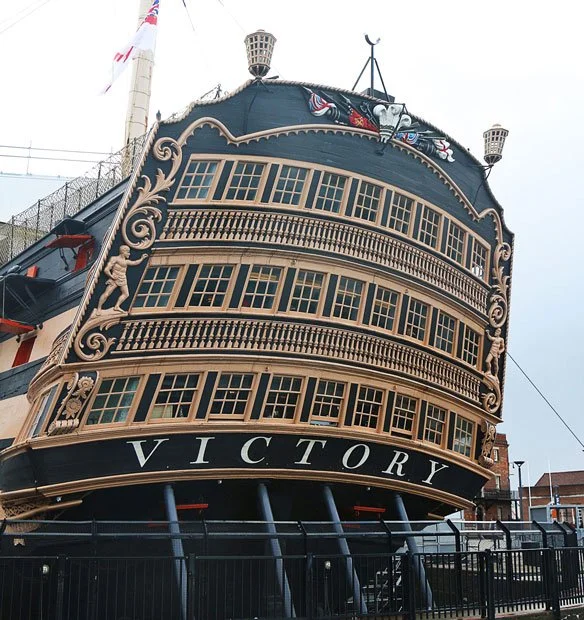
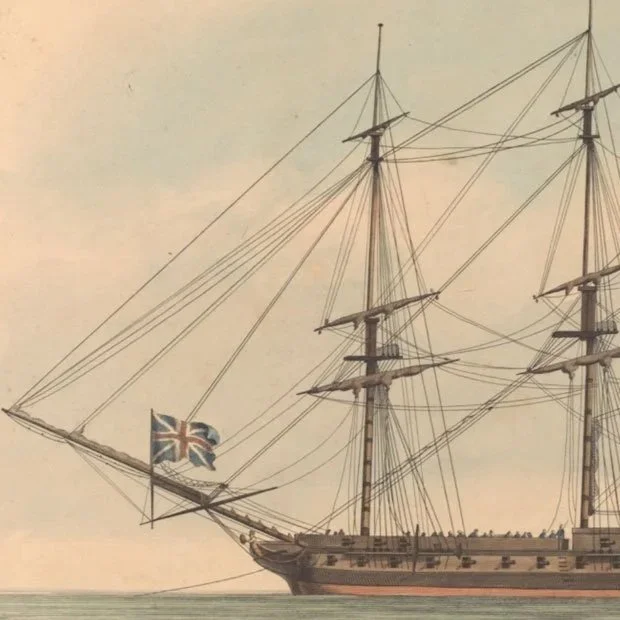
HMS Victory was Lord Nelson’s flagship at the Battle of Trafalgar.
Britain is littered with information plaques telling stories from the Regency era.
A sequence of these historical markers marks the route that vital news took when it was delivered in November 1805. That route is now known as the Trafalgar Way.
It’s a reminder that, until the arrival of the telegraph, news rarely travelled faster than a galloping horseman. Weeks, even months, might pass before people received news of major events which could impact their lives.
Putting the message in a Pickle
The Battle of Trafalgar, 21 October 1805, was significant for many reasons. It secured British sea power during the Napoleonic War, but it also brought the death of naval hero Admiral Lord Nelson.
It also affected thousands of British families who had sons or fathers serving (willingly or otherwise) with the fleet. Some would come home able to say, ‘I was there’. Others never came home at all.
In the hours, indeed days, after the battle, almost no one except those in the fleets knew what had happened.
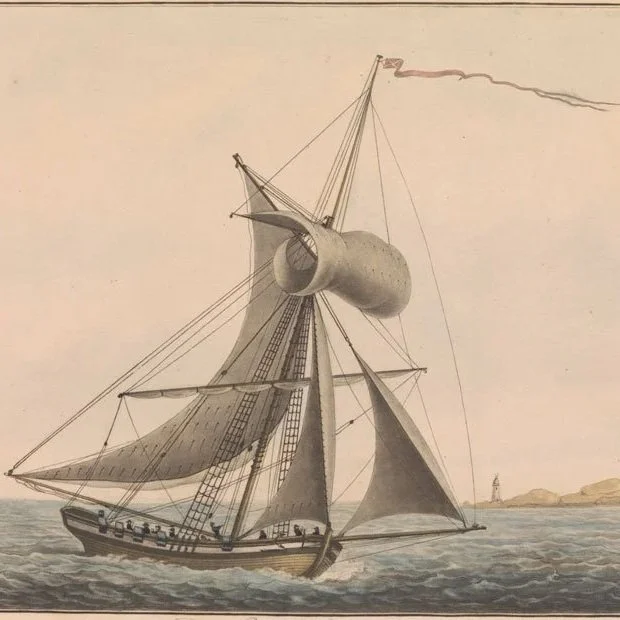
Vice Admiral Collingwood wanted to get the news to the Admiralty in London as soon as possible. So he put dispatches, telling what had happened, into the hands of Lieutenant Lapenotiere, captain of the schooner HMS Pickle.
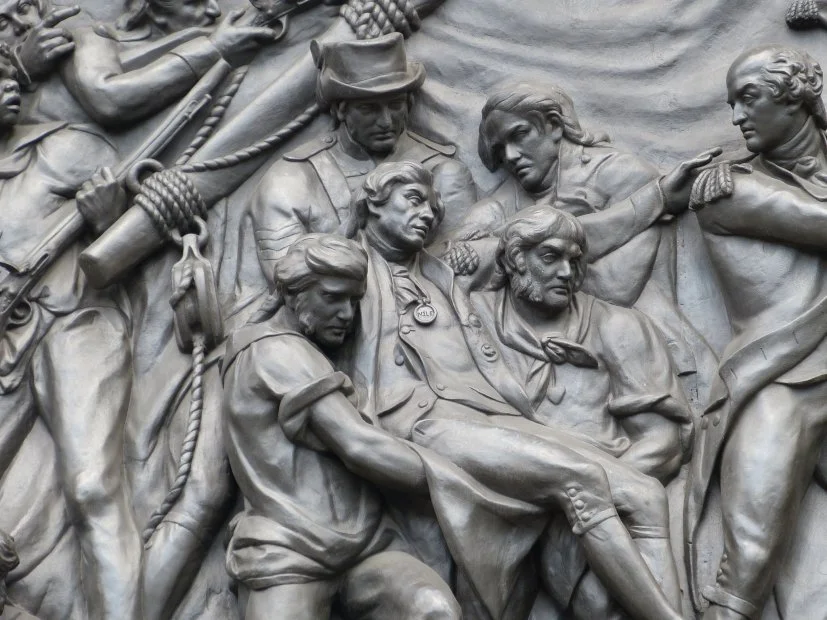
Detail of frieze on Nelson's column Trafalgar Square, showing Nelson being carried from where he had fallen.
One messenger becomes two
Early in his journey to England, Lapenotiere encountered HMS Nautilus, under Captain John Sykes. The two senior officers met and it’s suggested that Sykes wanted to take on the role of courier, because of the prestige that came with it.
Soon after sending Lapenotiere on his way, Sykes decided to follow. In his dispatch to Collingwood, he states that he is acting to ensure the news carried by the Pickle makes it to the intended destination.
Finding the fastest route to London
Lapenotiere landed at Falmouth, in south-west England, on 4 November. It was two weeks since the battle at Trafalgar, and no one in Britain knew about it.
The lieutenant’s job was to get his messages to London as soon as possible. Falmouth was 270 miles from the capital and the fastest way to travel was by the post roads.
Post roads were built, and looked after, to help coaches travel as fast as possible. They were kept relatively smooth, and traffic was managed to keep slower vehicles out of the way.
Getting the fastest speeds meant combining good roads with fresh horses. Inns positioned every few miles along the post roads provided a regular source of stabled and rested horses.
As soon as he could, Lapenotiere set out from Falmouth in a post-chaise, a carriage drawn by four horses. Did he know that Sykes was close behind, keen to deliver the news he’d heard from the lieutenant?
The race across 270 miles of England
It’s likely that Lapenotiere was aware of what Sykes was up to, as his ship had spotted HMS Nautilus as they approached England.
Sykes, however, may not have known that HMS Pickle had made it to England. He landed at Plymouth and, on sharing the news with an admiral, was sent to London to inform the commanders of the navy.
What we do know is that both men were racing along the post roads at about the same time, making for the same Admiralty Board in London.
An eye-witness recorded seeing the two officers pass through Dorchester, in Dorset:
On Tuesday 5th November at about noon, two officers of the navy came through this town, following each other, at about an hour's space of time, in two post-chaises and four horses to each, from the westward; the first reported that he brought good news of great importance, and the second, that his despatches contained the best and most capital news that the nation ever experienced.
Who was in the lead at Dorchester? It’s suggested that Sykes was out front, which would have frustrated Lapenotiere.
Delivering the bad news and the good
Today it would take around 6 hours to drive from Falmouth to the Admiralty in London. I could do that with perhaps one or two short breaks.
In 1805, the journey required at least 21 stops to change horses. We know this because Lapenotiere submitted a detailed expense report, which tells us where he stopped.
We also know both officers came into a foggy London on the evening of 5 November. It’s suggested this is where Sykes lost his way, allowing Lapenotiere to reach the Admiralty first.
At 1am he was shown into the Admiralty Board Road, where First Secretary William Marsden was still working. He recorded the officer’s words: ‘Sir, we have gained a great victory, but we have lost Lord Nelson.’
Sykes arrived a few minutes later.
The Trafalgar Way
Through a combination of Lapenotiere’s expense report and post road maps it’s been possible to trace much of the route taken by the two officers. In 2005, to mark the 200th anniversary of the journey, plaques were put up to mark points they had passed.
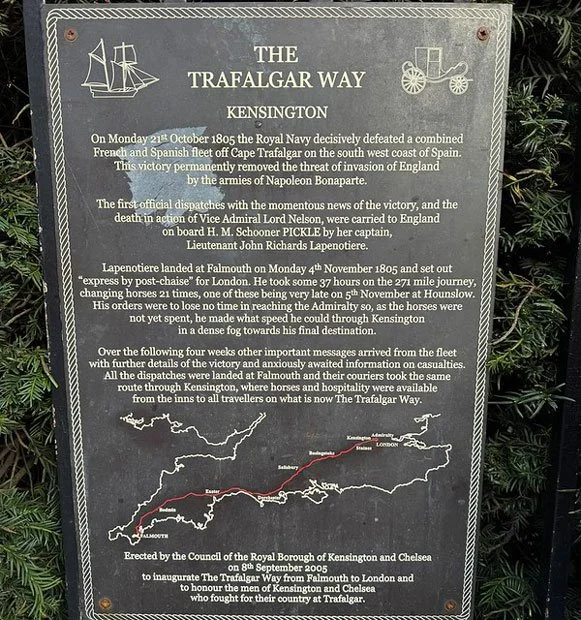
Plaque marking The Trafalgar Way, at the entrance to Holland Park, Kensington.
Andrew Knowles researches and writes about the late Georgian and Regency period. He’s also a freelance writer and editor for business. He lives with his wife Rachel, co-author of this blog, in the Dorset seaside town of Weymouth.
If you have enjoyed this blog and want to encourage us and help us to keep making our research freely available, please buy us a virtual cup of coffee by clicking the button below.
Notes or sources
This is one source
This is another
Regency History
by Andrew & Rachel Knowles

We research and write about the late Georgian and Regency period.
Rachel also writes faith-based Regency romance with rich historical detail.