
Ackermann’s Repository of Arts
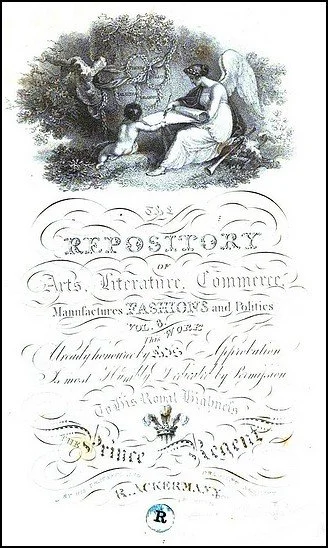
Frontispiece of Ackermann's Repository (Vol VIII July 1812)
The Repository of Arts, Literature, Commerce, Manufactures, Fashions, and Politics was a monthly periodical that was published from January 1809 to December 1828 by Rudolph Ackermann. It is often referred to as Ackermann’s Repository of Arts or simply Ackermann’s Repository.
As its full name suggests, Ackermann’s Repository was not just a fashion periodical but covered a wide range of subjects within its pages. The magazine included travel writing and poetry, comments on the arts and details of new publications, society reports, forthcoming lectures and musical reviews. It also included more serious material – a ‘retrospect of politics’, reports on law, medicine and agriculture, a meteorological journal and details of the London markets.
The Repository was quite an expensive magazine - in 1817 its cover price was 4s which is equivalent to over £14 in 2018. 1
Cultivating a taste for the arts
In the first issue, published for January 1809, Ackermann included an ‘introduction to the history of the useful and polite arts’ which said:
It is universally admitted, that to cultivate a taste for the arts, and an acquaintance with the sciences, is a pleasure of the most refined nature; but to do this without regard to its influence upon the passions and affections, is to ‘tear a tree for its blossoms, which is capable of yielding the richest and most valuable fruit.’ The cultivation of this taste may and ought to be subservient to higher and more important purposes: it should dignify and exalt our affections, and elevate them to the admiration and love of that Being who is the author of every thing that is fair, sublime, and good in nature. 2
A fashion periodical
Ackermann’s Repository included two fashion plates every month, complete with full descriptions of the illustrations. 3 In this, it was a rival magazine to La Belle Assemblée, which had been printing two fashion plates each month since its inauguration in February 1806.
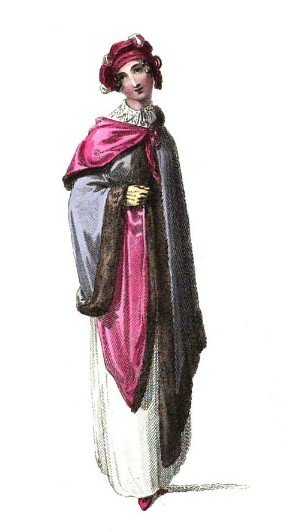
Promenade or carriage costume from Ackermann's Repository (Mar 1814)
The description of the promenade costume shown reads:
A white cambric robe, with full long sleeves, unornamented at the feet. Deep double Vandyke frill of lace, tied with a white cord and tassel at the throat; a deep Vandyke cuff of the same. The Austrian shawl cloak, composed of pale dove-coloured cloth, lined throughout with rose-coloured satin or sarsnet, trimmed entirely round with a broad sable fur; a fancy cape or hood terminating in front of the bosom, and tied with a rose-coloured ribbon. A Circassian turban cap, composed of crimson velvet, ornamented with tufts of rose-coloured satin; a rich silk cord round the edge, terminated on one side with correspondent tassels. Hair in full curls on each side, much divided in front of the forehead. Half-boots of crimson velvet. Gloves of lemon-coloured kid, or pale tan colour. 3
The Repository also included coloured plates of ‘fashionable furniture’.
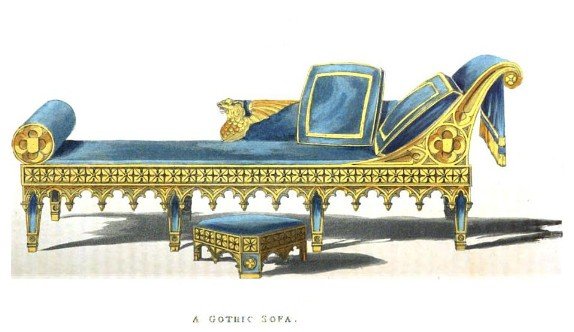
A Gothic sofa from Ackermann's Repository (Dec 1825)
Promoting British manufactures
One of the aims of Ackermann’s Repository was to promote British manufacture and one way that it did this was to include ‘allegorical wood-cuts’ which showed patterns from different manufacturers and included real fabric samples.
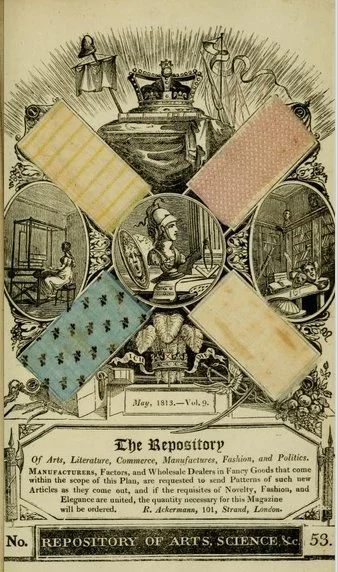
Woodcut from Ackermann's Repository (May 1813)
The first issue of The Repository explained how these woodcuts could promote British manufactures:
Patterns afford the manufacturer an opportunity of circulating a new article more extensively in one day, than can be done by sending a dozen riders with it through the country. It will likewise afford persons at a distance from the metropolis the means of examining and estimating the merit of the fabric, and of being made acquainted with the tradesman from whom it may be purchased. 4
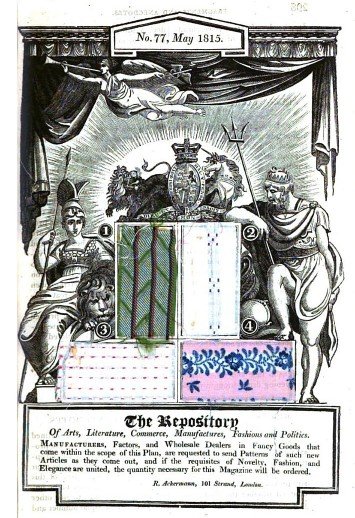
Woodcut from Ackermann's Repository (May 1815)
The note on the allegorical woodcut reads:
Manufacturers, Factors, and Dealers in Fancy Goods, that come within the scope of this Plan, are requested to send Patterns of such new Articles, as they come out: and if the requisites of Novelty, Fashion and Elegance, are united, the quantity necessary for this Magazine will be ordered. R Ackermann, 101, Strand, London. 5
Advertisements
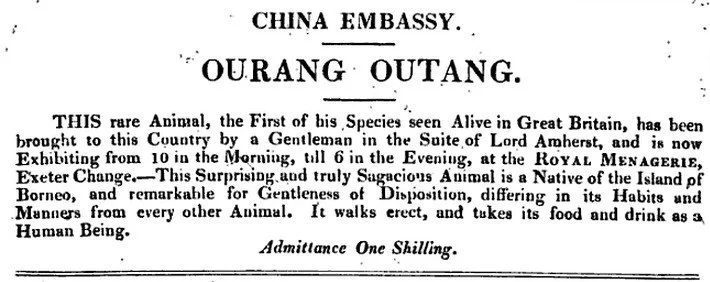
Advertisement from Ackermann's Repository (Sept 1817)
Every month, advertisements appeared offering a wide variety of goods, services and entertainments to the fashionable readers of Ackermann's Repository. These included such diverse items as:
Marston’s patent stays and corsets
Dyeing balls
Cures for rheumatism
Tooth powder and artificial teeth
Fragrances, such as Otto of Roses
Ackermann’s own prints
New publications
Magic lanterns
The Royal Menagerie at the Exeter Change (above)
Lottery tickets
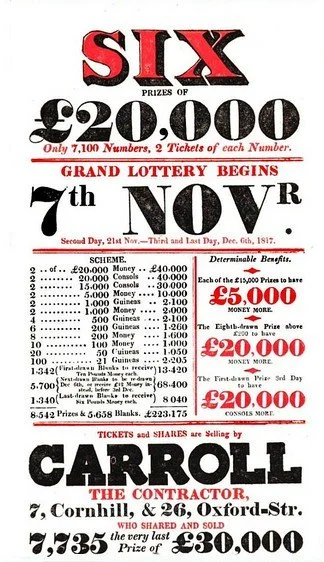
Advertisement for a lottery from Ackermann's Repository (Nov 1817)
Rachel Knowles writes faith-based Regency romance and historical non-fiction. She has been sharing her research on this blog since 2011. Rachel lives in the beautiful Georgian seaside town of Weymouth, Dorset, on the south coast of England, with her husband, Andrew, who co-writes this blog.
If you have enjoyed this blog and want to encourage us and help us to keep making our research freely available, please buy us a virtual cup of coffee by clicking the button below.
Notes
1. Measuring Worth website. For more information on relative prices, see our article:
2. Ackermann's Repository of Arts (January 1809).
3. Ackermann's Repository of Arts (March 1814).
4. Ackermann's Repository of Arts (January 1809).
5. Ackermann's Repository of Arts (May 1815).
Sources used include:
Ackermann, Rudolph, The Repository of Arts, Literature, Commerce, Manufactures, Fashions and Politics (1809-1828)