
A ball at Almack's in 1815
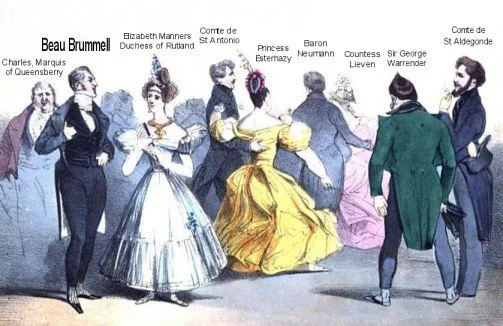
A ball at Almack's in 1815 (annotated) from Celebrities of London and Paris by Captain Gronow (1865)
My post on Almack’s Assembly Rooms was originally illustrated by the above picture, supposedly depicting a ball at Almack’s in 1815. It comes from Gronow’s reminiscences and is accompanied by a detailed description:
The personages delineated in the frontispiece are well worthy of notice, both from the position they held in the fashionable world, and from their being represented with great truth and accuracy. On the left, the man with the red face, laughing at Brummell, is Charles, Marquis of Queensberry; the great George himself, the admirable Crichton of the age, comes next, in a dégagé attitude, with his fingers in his waistcoat pocket. His neck-cloth is inimitable, and must have cost him much time and trouble to arrive at such perfection. He is talking earnestly to the charming Duchess of Rutland, who was a Howard, and mother to the present Duke.
The tall man, in a black coat, who is preparing to waltz with Princess Esterhazy, so long ambassadress of Austria in London, is the Comte de St Antonio, afterwards Duke of Canizzaro. He resided many years in England, was a very handsome man, and a great lady-killer, and married an English heiress, Miss Johnson. The stout gentleman waltzing with the Russian ambassadress, Countess, afterwards Princess Lieven, is Baron Neumann, at that time secretary to the Austrian embassy. He was afterwards minister at Florence, and married a daughter of the Duke of Beaufort’s.
We next behold, in a wonderful light green coat, black tights, and a crushed hat, the late Sir George Warrender, the famous epicure, whose name was pronounced by Sir Joseph Copley to be really Sir Gorge Provender. The worthy Baronet is talking to the handsome Comte de St Aldegonde, afterwards a general, and at this period aide-de-camp to Louis Philippe, then Duke of Orleans.
The original sketch was given to Brummell by the artist who executed it; and it was highly prized by the king of the dandies. It was purchased at the sale of his effects in Chapel Street by the person who gave it to me.
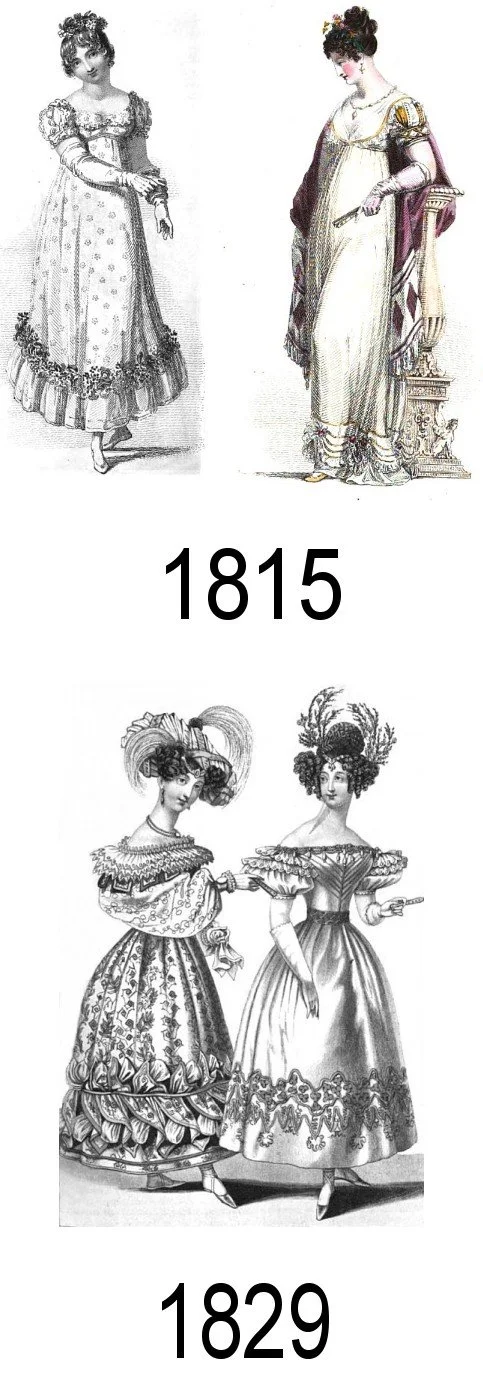
Top left: Ball dress (Jun 1815) & Top right: Evening dress (Feb 1815) from Ackermann's Repository
Bottom left: Evening dress (Apr 1829) & Bottom right: Ball dress (Apr 1829) from La Belle Assemblée
But did this ball really take place in 1815?
The problem with this picture is that it is dated 1815 and yet the ball dresses clearly belong to a later period. Having examined fashion prints from Ackermann’s Repository and La Belle Assemblée, I think that the gowns depicted belong to the late 1820s. (Compare the dresses from 1829 with those in the picture.)
And it is not only the ladies’ fashions that are wrong. The correct attire for gentlemen at Almack’s at this time was knee breeches, white cravat and chapeau bras. In the picture, the gentlemen are wearing pantaloons or trousers and the hats held by Sir George Warrender and the Comte de St Aldegonde look more like the collapsible top hats that became popular in the 1820s than the correctly formal chapeau bras.
So was the ball held in, say, 1829 rather than 1815? Well no, it cannot have been. The artist unmistakably identifies Beau Brummell in black on the left-hand side of the picture. Brummell left England for France in May 1816 to escape his debts and so if Brummell was at the ball, it must have been before May 1816 at the very latest.
A possible explanation
My theory is that part or possibly the entire sketch was done from memory and that the artist got some of the details wrong. In the days before cameras, there was no quick way to record a scene and I think we underestimate how often artists must have worked from memory. In this picture, various individuals were carefully drawn and identified; one can only assume that the fashions were of lesser importance to the artist.
Logically, it seems probable that the picture was drawn many years after the event, most likely at the time when the fashions represented were prevalent. The only problem with this notion is that Gronow claimed that he was given the sketch by someone who had bought it at the sale of Brummell’s possessions at his old home in Chapel Street which took place on 22 May 1816.
However, I can more readily believe that the sketch got into Gronow’s hands by a different route than that the artist was able to predict fashions some 14 years into the future!

The first quadrille at Almack's c1815 from The Reminiscences and Recollections of Captain Gronow (1889) showing the correct dress for Almack's in 1815
Rachel Knowles writes faith-based Regency romance and historical non-fiction. She has been sharing her research on this blog since 2011. Rachel lives in the beautiful Georgian seaside town of Weymouth, Dorset, on the south coast of England, with her husband, Andrew, who co-writes this blog.
If you have enjoyed this blog and want to encourage us and help us to keep making our research freely available, please buy us a virtual cup of coffee by clicking the button below.
Sources used include:
Ackermann, Rudolph, The Repository of Arts, Literature, Commerce, Manufactures, Fashions and Politics (various)
Bell, John, La Belle Assemblée (John Bell, 1806-1837, London)
Chancellor, E. Beresford, Memorials of St. James’s Street and Chronicles of Almack’s (1922)
Gronow, Captain RH, Celebrities of London and Paris, being a third series of reminiscences and anecdotes (1865)
Gronow, Captain, The Reminiscences and Recollections of Captain Gronow (1850, 1862, 1889, 1892)